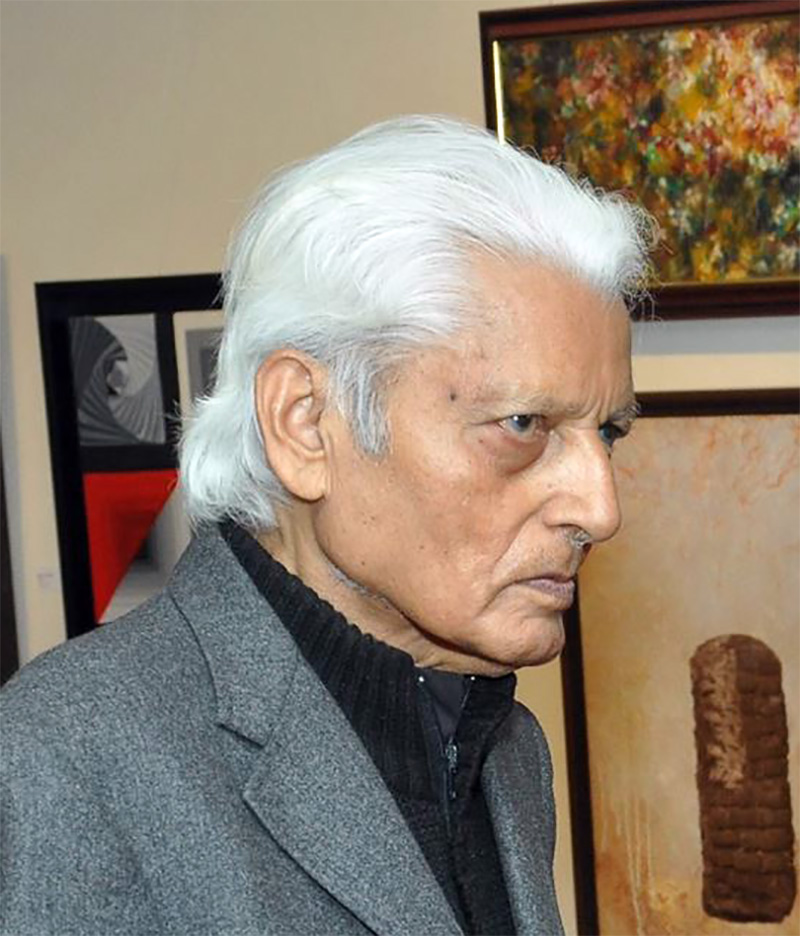
Prof. Raj Jain: Master Artist, Inspiring Teacher, and Accomplished Flutist
Prof. Raj Jain (1931–2018) was one of the most respected figures in the art landscape of Northern India. For over four decades, he dedicated his life to the pursuit of art, education, and music, leaving an indelible mark on generations of artists and students. In an era often shaped by fleeting trends and intense competition, he remained steadfast in his commitment to creativity, integrity, and artistic excellence.
As an educator, Prof. Jain played a pivotal role in popularizing fine arts and making them accessible to a wider audience. Through his passionate teaching of drawing, painting, mural art, oil painting, acrylics, and other visual art forms, he nurtured countless students from diverse backgrounds, inspiring them to develop their own artistic voices.
Born in Kota, Rajasthan, in 1931, Raj Jain earned his National Diploma in Art from Delhi Polytechnic, New Delhi, in 1961. He began his teaching career at Triveni Kala Sangam, New Delhi, where he served as Teacher In-Charge of the Art Department. In 1966, he joined the Government College of Art, Chandigarh, where he taught painting until 1989 and became one of its most admired professors.
As a painter, Raj Jain developed a distinctive visual language. His works evolved from early depictions of everyday subjects, such as benches and crows, into rich compositions featuring peacocks, human figures, and elements of nature, often juxtaposed against the barriers and complexities of modern urban life. His paintings reflected both poetic sensitivity and keen social observation.
Beyond the canvas, Prof. Jain was an accomplished bansuri (flute) player and a dedicated practitioner of Indian classical music. His performances combined deep respect for tradition with a spirit of innovation, earning him recognition as a gifted flutist. For many years, his flute recitals became highlights of cultural events at the College of Art, Chandigarh, where students eagerly gathered to experience his music. Alongside painting, he taught bansuri, Indian classical vocal music, and guided students in the appreciation of instruments such as the sitar, tanpura, and harmonium.
His contributions to art were widely recognized. Among his many honors were the Sailoz Mukherjea Prize (1961), awards at the All India Graphic Exhibitions (1976), the Punjab Lalit Kala Akademi Award (1978), and the Chandigarh Lalit Kala Akademi Awards (1980 and 1981). He was also honored by the All India Fine Arts and Crafts Society (AIFACS), New Delhi, for his outstanding artistic achievements.
Throughout his distinguished career, Prof. Jain participated in numerous art camps, workshops, and exhibitions across India. His works featured in prestigious exhibitions including the National Exhibitions of Lalit Kala Akademi, Triennale India, AIFACS Annual Shows, and several landmark exhibitions that helped shape post-independence Indian art discourse. He also held successful solo exhibitions in Chandigarh, Patiala, and Shropshire (United Kingdom).
In recognition of his lifelong contribution to art education and creative practice, Prof. Raj Jain received the Lifetime Achievement Award during the Diamond Jubilee Convocation of the Government College of Art, Chandigarh, in April 2012. He was further honored by the Chandigarh Lalit Kala Akademi during a state function in 2014.
Working from his studio in Gurgaon, Haryana, Prof. Raj Jain continued to paint, teach, and inspire until the final years of his life. His legacy lives on through his remarkable body of work, his music, and the countless students whose artistic journeys were shaped by his wisdom and generosity.
Prof. Raj Jain passed away on 7 November 2018. Though he is no longer with us, his contributions to Indian art and culture continue to resonate, ensuring that his spirit remains alive in every canvas, every melody, and every artist he inspired.

