

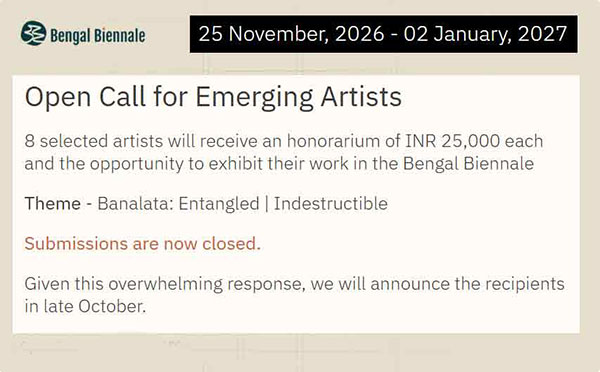
Exploring Buried Histories, Ecologies, and Collective Survival Through Contemporary Art
The highly anticipated second edition of the Bengal Biennale will open across Kolkata and Santiniketan from 25 November 2026 to 2 January 2027, reaffirming its position as one of India’s most ambitious contemporary art initiatives. Organized by the Gameplan Foundation, the biennale seeks to create meaningful conversations between art, ecology, memory, and society through a dynamic network of cultural and historical venues.
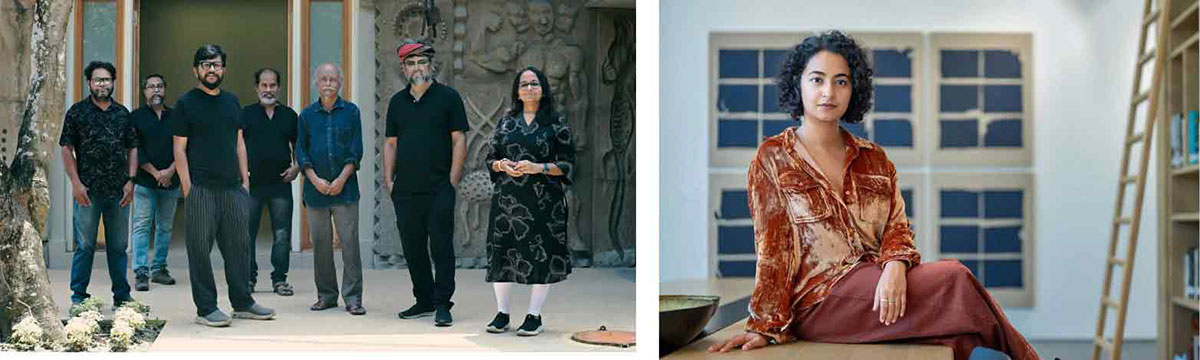
Co-curated by the acclaimed artist collective Chander Haat and independent curator Ritika Biswas, the 2026-27 edition unfolds under the curatorial theme“Banalata,” inspired by the celebrated poem Banalata Sen by Bengali poet Jibanananda Das and the intertwined ecology of wild forest vines. The theme serves as a metaphor for hidden connections, resilience, resistance, and collective survival in an increasingly fragmented world.
The biennale will activate a series of significant venues across both cities. In Santiniketan, participating spaces include Nandan Art Museum & Gallery, Tokaroun, Santiniketan Society of Visual Art & Design (SSVAD), Arthshila, Sculpture Park, Somnath Hore Studio, and Krittika Arts Space. Kolkata venues include The Alipore Museum, The Indian Museum, TRI Art & Culture, Lalit Kala Akademi, The Red Bari, The Dockyard Co, and Kolkata Centre for Creativity (KCC).
Unlike conventional exhibition formats, the Bengal Biennale views its venues as active participants in the artistic narrative. Former prisons, historic houses, public spaces, and ecological sites will become platforms for artistic engagement, encouraging visitors to encounter the layered histories and living cultures of Bengal through contemporary practice.
Bengal Biennale was launched in 2024 and quickly gained recognition for its decentralized approach, bringing together more than 100 artists across over 25 venues. The second edition aims to deepen that vision, connecting local histories with global artistic discourse while strengthening the cultural dialogue between Kolkata and Santiniketan, two places intrinsically linked to Bengal’s artistic legacy.
Speaking about the curatorial concept, Chander Haat emphasized the collective’s belief that art is fundamentally a way of building relationships and fostering coexistence. Meanwhile, Ritika Biswas described Banalata as an exploration of emotional, ecological, and political entanglements that shape contemporary life, inviting audiences to reflect on new forms of kinship and solidarity.
The biennale is spearheaded by trustees Jeet Banerjee and Malavika Banerjee, who envision the event as a space where contemporary artistic practices can illuminate lessons of resilience and interconnectedness offered by nature and society. Their efforts continue to position Bengal as a vibrant destination within the international art landscape