The Open Palm Art Gallery at India Habitat Centre is alive with creativity as it hosts Art Spectra, a dynamic Group Art Exhibition curated by Amrita Prakash. Inaugurated on 11 August at 5:30 P.M., the exhibition runs until 16 August 2026, offering audiences a rare opportunity to experience the breadth of contemporary artistic expression.
A Distinguished Inauguration
The opening ceremony was graced by eminent figures from art, culture, and public life:
- Elena Barman, President of IARC-MAPC.
- Paramjeet Singh, eminent artist.
- Gaurav Gupta, Founder President of the Global Trade and Technology Council of India.
- Leeladhar Mandloi, former DG of Doordarshan, poet, writer, and abstract photographer.
- Payal Kapoor, interior architect.
Their presence underscored the exhibition’s mission to foster cross-disciplinary appreciation of art.
Participating Artists
The exhibition features 25 artists, each contributing distinctive perspectives and techniques. Among them are Leeladhar Mandloi, Amit Varikhan, Sanju Das, Nidhi Charan, Rajkumar Sanyuan, Deepali Mittal, Komal Agarwal, Smita Singh, Diti Rekha Gayan, Susmala Chatterjee, Baishakhi Chatterjee, Mohan Subramani, Swagata Gopinathan, Agrita Som, Subuhi Khan, Dr. Aakanksha Gupta, Vishakha Sahu, Amita Roy Choudhury, Preeti Pereira, Neha Kaul, Banita Rani Singh, Agrijita, Purnima Gupta, and Simret Singh.
Spotlight: Editor’s Favourite Artist — Simret Singh
Among the many voices, Simret Singh’s works emerged as a highlight, earning her the distinction of Editor’s Favourite Artist. Her paintings explore profound themes of transformation, spirituality, and the interplay of darkness and light.
Birth of a Peacock (Oil on canvas, 19 × 22 inches)
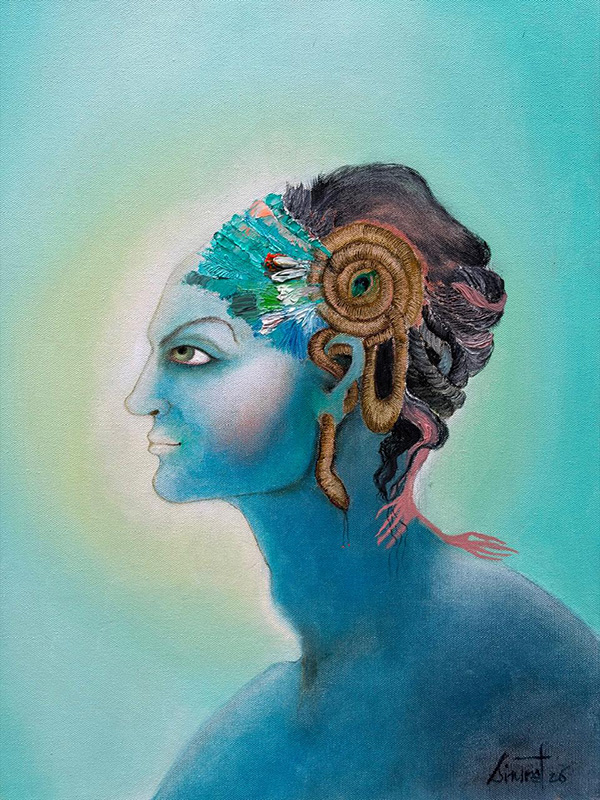
This painting explores the transformative power of thought. The serpent, long associated with fear, instinct, and limiting patterns, gradually gives birth to the peacock—a symbol of beauty, wisdom, and higher consciousness. The metamorphosis takes place within the mind, suggesting that every noble action first begins as an inner transformation.The work proposes that darkness and light are not opposing forces but stages of the same journey. Negative thoughts, when understood and transcended, become the source of growth, clarity, and renewal. The peacock is therefore not born despite the serpent, but through it—a reminder that our greatest strengths often emerge from the very struggles we overcome. /Simret Singh
Shiva and the Peacock (Oil on canvas, 20 × 30 inches)
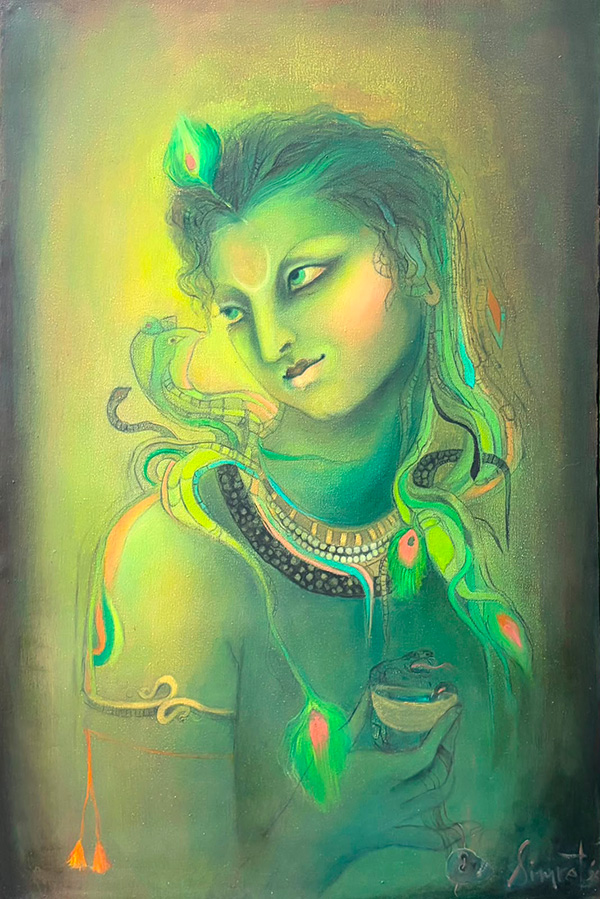
This painting explores the transformative nature of the divine.According to a traditional narrative, Shiva—adorned with ashes, serpents, and the emblems of mortality—wishes to enter the ecstatic dance of Krishna and the Gopis. Because of his fierce and fearsome appearance, however, he is stopped by the Gopis and prevented from entering. He then transforms the very symbols that surround him. Serpents become peacocks. Death becomes beauty. Fear becomes celebration. Negativity becomes possibility.Another tradition affirms an even deeper truth: Shiva and Krishna are not separate. Shiva merges into Krishna, and Krishna into Shiva, revealing that the many forms of the divine are expressions of a single, indivisible reality.The painting proposes that destruction and creation are not opposing forces but complementary aspects of the same cosmic process. Shiva’s role as destroyer is not one of annihilation but of renewal—the dissolution of what has outlived its purpose, making way for beauty, life, and new possibilities to emerge. The peacock thus becomes more than a symbol of beauty; it becomes an emblem of transformation, reminding us that what is feared can be transmuted into what is celebrated. /Simret Singh
Her works captivated audiences with their philosophical depth and visual poetry, embodying the exhibition’s spirit of renewal and transcendence.